
What Research Supports Mag41™?

By Ryan Harris, Ingredient Content Specialist, Compound Solutions
What the Science Shows
Mag41™ stands on a broader scientific foundation than the magnesium category usually reflects. Research on magnesium supports its role in energy production, nerve signaling, muscle contraction, insulin signaling and hundreds of other functions. Research on acetate points to short-chain fatty acid (SCFA) signaling, acetyl-CoA (energy) production and broader metabolic activity. That is why magnesium and acetate both belong in all-day wellness formulas.
In one sentence: The science behind Mag41™ supports a magnesium form built for daily energy, metabolism, muscle function and active lifestyle formulas designed for daytime use.
Research highlights: energy production, metabolism, key metabolic pathways, muscle contraction, acetate signaling and acetylation for major processes such as acetyl-CoA and acetyl choline production.
Why this matters: Mag41™ does not rely on one narrow magnesium talking point. It draws from both magnesium science and acetate science to support an all-day use case.
What kind of research supports Mag41™?
The research behind Mag41™ comes from more than one direction.
First, magnesium itself has a strong scientific foundation. It plays a role in ATP-related processes, metabolism, insulin signaling, muscle function and broader cellular activity. Second, acetate has its own scientific relevance. As a short-chain fatty acid (SCFA), acetate is involved in maintaining a healthy metabolism and insulin sensitivity, metabolic signaling, acetyl-CoA production and broader SCFA biology. Third, Mag41™ points to three especially important areas: energy production, key metabolism pathways and muscle contraction.
What does the science say about magnesium and metabolism?
Magnesium plays a role in more than 300 enzymatic reactions in the body. That alone makes it arguably the most important mineral in human physiology.
The science behind magnesium supports a healthy metabolism, ATP (energy) synthesis, insulin signaling, muscle contraction, nerve function and broader cellular activity. When magnesium status drops, the body does not lose support for one narrow function; it loses support across a much larger network of processes. That is one reason magnesium should not be viewed only through the lens of sleep. The science on magnesium has always been broader than the way the category usually presents it.
How does magnesium connect directly to ATP?
Magnesium is essential for energy production, because ATP is not activated until it binds with magnesium. For adenosine triphosphate (ATP) to be biologically active, it must be bound to magnesium. Magnesium is directly tied to the body’s energy systems. Research on magnesium complexes ties magnesium directly to ATP biology and describes magnesium as required for energy production, oxidative phosphorylation and glycolysis. The magnesium-ATP complex shows up as a core part of biochemical energy conversion, which gives formulators a much more concrete way to think about magnesium status: when magnesium is low, energy-related systems are low.
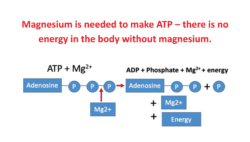
And this is where the sequence becomes even more interesting for Mag41™. Before ATP enters the picture, acetate sits upstream through acetyl-CoA. Research links acetate, the short-chain fatty acid (SCFA), to acetyl-CoA production, which creates a cleaner scientific bridge into magnesium acetate. Acetate feeds into acetyl-CoA. Magnesium ties directly into ATP-related biology. That sequence makes the magnesium-acetate pairing feel much more purposeful in a metabolism-centered formula.
For readers who want to go deeper on magnesium-ATP biology, check out: The Coordination Chemistry of Bio-Relevant Ligands and Their Magnesium Complexes.
What does the science say about acetate?
This is where the Mag41™ research gets especially interesting.
Acetate is one of the major short-chain fatty acids (SCFAs) produced when fiber is fermented in the gut. Research on acetate and SCFAs points to roles in metabolism signaling, GPR41 and GPR43 activity, GLP-1 and PYY release, AMPK-related activity and broader metabolic regulation. Acetate brings its own scientific relevance, which explains why magnesium acetate stands apart from more familiar forms like glycinate, citrate and malate.
Why does acetyl-CoA matter in the Mag41™ discussion?
Acetyl-CoA sits at the center of energy production.
One of the strongest technical points behind magnesium acetate is the connection between acetate and acetyl-CoA. Acetate is the precursor molecule for the activation and formulation of acetyl-CoA – the central molecule in energy production. At the same time, magnesium supports ATP-related processes and the enzyme-driven systems that help those processes run. That gives magnesium acetate a stronger functional foundation than standard magnesium forms chosen mainly for familiarity. It explains why Mag41™ belongs in energy and metabolism-focused all-day products.
How does the research point beyond sleep?
Magnesium and acetate research supports their use as ingredients in all-day wellness formulas–not only calm and sleep products.
Magnesium science supports a healthy metabolism, muscle function, insulin sensitivity and daily energy production. Acetate science supports metabolic signaling, acetyl-CoA production and energy-related pathways. Together, they support a magnesium form that makes sense in active lifestyle formulas built for daytime use. That gives formulators a stronger scientific foundation for placing magnesium in products built around daily energy, metabolism and daytime use.
What should formulators take from the research?
Formulators should see Mag41™ science as multi-layered.
At the magnesium level, the ingredient draws on a strong body of science around metabolism, ATP-related processes, muscle function and insulin sensitivity. At the acetate level, the ingredient draws on short-chain fatty acid (SCFA) biology, acetyl-CoA production and signaling pathways that make magnesium acetate more than just another salt form. At the ingredient level, Mag41™ brings those pieces together in a form designed for active lifestyle products, daytime use and functional beverages. That is what makes the science so useful. It supports the logic behind the form itself, not just one isolated claim.

What should brands take from the research on Mag41™?
The biggest takeaway is that Mag41™ has a broader scientific base than the magnesium category usually reflects.
The research spans magnesium’s critical role in broad human physiology, and acetate’s foundational role as a short-chain fatty acid (SCFA) in maintaining healthy metabolism-related processes. That gives brands a stronger foundation for products built around daily energy, active lifestyle and daytime uses. The science shows that Mag41™ belongs in a different magnesium conversation.
FAQ
Is there real science behind Mag41™?
Yes. Mag41™ draws on both magnesium science and acetate science, including support tied to energy production, key metabolic pathways, insulin sensitivity and muscle contraction.
Is magnesium directly connected to ATP?
Yes. Magnesium is directly tied to ATP biology and is required for energy production, oxidative phosphorylation and glycolysis. That is one reason magnesium status matters so much for all-day energy systems.
Does magnesium research go beyond sleep support?
Yes. Magnesium research extends into energy metabolism, ATP-related processes, muscle contraction, nerve signaling and broader cellular function throughout the day.
What does the research say about acetate?
The research links acetate to metabolic signaling, acetyl-CoA production, GPR41 and GPR43 activity, GLP-1 and PYY release and broader short-chain fatty acid (SCFA) interactions.
Why does acetyl-CoA keep coming up in discussions about Mag41™?
Because it sits at the center of energy production. The connection between acetate and acetyl-CoA explains why magnesium acetate has a strong energy-centered foundation.
How do acetate and magnesium work together in Mag41™?
Acetate sits upstream through acetyl-CoA, while magnesium is directly tied to ATP-related energy systems. Together, they give Mag41™ (magnesium acetate) a stronger scientific fit for metabolism-focused all-day formulas.
Does the science support Mag41™ for active lifestyle formulas?
Yes. There is no energy production without magnesium. The science supports a magnesium form tied to metabolism, muscle function and broader all-day energy, which aligns well with active lifestyle product concepts.
Is Mag41™ backed by more than theory?
Yes. Mag41™ rests on a broader scientific foundation that includes magnesium’s role in the body, including acetate signaling, support for energy production, metabolic pathways, insulin sensitivity and muscle function.
What should formulators take away from the research?
Formulators should see Mag41™ as a magnesium form with a stronger technical foundation for metabolism-focused, daytime and active lifestyle products than the category usually gives magnesium credit for.
Want to Turn Stronger Science into a Stronger Formula?
Reach out to us at sales@compoundsolutions.com to learn more about how Mag41™ brings magnesium and acetate together in a form built for hydration products, stick packs, RTDs and functional beverages. We’re here to collaborate with you on your next product!
Ryan Harris writes about ingredient science and formulation at Compound Solutions, translating the information behind CSI’s patented ingredients into practical guidance for the formulators, R&D teams and brands building with them.